










# Programming for Beginners: Your Witty, No-Nonsense Guide to Writing Your First Lines of Code
**Meta Description:** Discover programming for beginners with free resources, basic concepts, and step-by-step tips to start coding today. Your journey begins here!
—
## Introduction
So you’ve decided to learn programming. Maybe you saw a movie where someone types furiously on a keyboard and suddenly hacks into a satellite. Spoiler alert: that’s not how it works. But here’s the good news — **programming for beginners** is far more accessible (and way less dramatic) than Hollywood suggests. Whether you’re a curious teenager, a career-switcher at 40, or someone who just wants to understand what their developer friend keeps ranting about at dinner, this guide is for you. We’ll walk through **basic programming concepts for beginners**, point you toward free resources, and even dabble in some real code. No satellites required. Let’s get into it — brought to you with love by **wearmaan**.
—
## What Exactly Is Programming? (And Why Should You Care?)
At its core, **computer programming for beginners** boils down to one beautifully simple idea: you’re giving a computer a set of instructions. That’s it. You’re essentially writing a very detailed recipe — except your kitchen is a machine that takes everything painfully literally.
Tell a human to “make toast,” and they’ll figure it out. Tell a computer to “make toast,” and it’ll stare at you blankly unless you specify which bread, which toaster slot, how long, and what to do when it’s done. Computers are powerful, but they have zero common sense.
Programming languages are the tools you use to communicate these instructions. Think of them as different spoken languages — Python, JavaScript, C++, Java — each with its own grammar, vocabulary, and quirks. Some are elegant. Some are… well, they get the job done.
**Why should you care?** Because programming is everywhere. Your phone, your car’s dashboard, that annoyingly addictive app you can’t stop scrolling — all built with code. Learning even the basics opens doors to:
– **Career opportunities** in tech, data science, and web development
– **Problem-solving skills** that transfer to virtually any field
– **Creative freedom** to build apps, automate boring tasks, or create games
– **A deeper understanding** of the digital world you live in every single day
You don’t have to become a software engineer. But understanding how code works is quickly becoming as fundamental as knowing how to write an email.
—
## Learn Programming Basics: The Core Concepts You Need First
Before you write a single line of code, let’s **learn programming basics** that apply to virtually every language out there. Consider these your programming ABCs.
### Variables
Variables are containers that store data. Imagine a labeled box: you put a value inside, slap a name on it, and reference it later. In Python, it looks like this:
“`
name = “wearmaan”
age = 5
“`
Simple, right? You just told the computer to remember two things.
### Data Types
Not all data is created equal. Numbers, text (called “strings”), lists, and true/false values (booleans) are the most common **examples of basic programming language** data types. Knowing the difference matters because you can’t subtract a word from a number — even computers have limits.
### Loops
Loops let you repeat actions without writing the same code fifty times. Need to print “Hello” ten times? A loop handles that in two lines instead of ten. Your fingers will thank you.
### Conditionals
These are your “if this, then that” statements. If the user enters the wrong password, show an error. If they enter the right one, let them in. Conditionals are how programs make decisions.
### Functions
Functions are reusable blocks of code. Instead of rewriting the same logic repeatedly, you package it into a function and call it whenever you need it. Think of it as meal prepping, but for code.
Master these five concepts, and you’ll have a **basic programming concepts for beginners** foundation sturdy enough to build on for years.
—
## How to Learn Programming for Free (Yes, Actually Free)
Here’s the part where your wallet breathes a sigh of relief. You absolutely can **learn programming for free**, and the resources available today are genuinely outstanding.
### Top Free Platforms
– **freeCodeCamp** — A full curriculum covering HTML, CSS, JavaScript, Python, and more. Completely free, community-driven, and wildly popular for good reason.
– **Codecademy (Free Tier)** — Interactive lessons that let you write code directly in your browser. Great for hands-on learners who hate reading textbooks.
– **Khan Academy** — Perfect for visual learners. Their computing courses break down concepts with animations and step-by-step exercises.
– **The Odin Project** — Specifically designed for web development. It’s thorough, opinionated, and completely **programming for beginners free**.
– **MIT OpenCourseWare** — Want university-level content without university-level debt? MIT literally gives away its course materials.
### YouTube Channels Worth Your Time
Channels like CS50 (Harvard’s intro to computer science), Traversy Media, and Corey Schafer offer hundreds of hours of high-quality tutorials. When people ask **how to learn programming online**, YouTube is honestly one of the best answers.
### Practice Platforms
Once you’ve learned the basics, sites like LeetCode, HackerRank, and Codewars let you solve coding challenges that sharpen your skills. Think of them as the gym for your programming muscles.
The key takeaway? Money is not a barrier. Time and consistency are. Set aside 30 minutes a day, pick one resource, and stick with it.
—
## How to Learn Programming for Beginners Step by Step
Knowing *where* to learn is one thing. Knowing *how* to approach it is what separates people who actually become programmers from those who buy a course and never open it. Here’s **how to learn programming for beginners step by step** — a practical roadmap you can start today.
### Step 1: Pick One Language and Commit
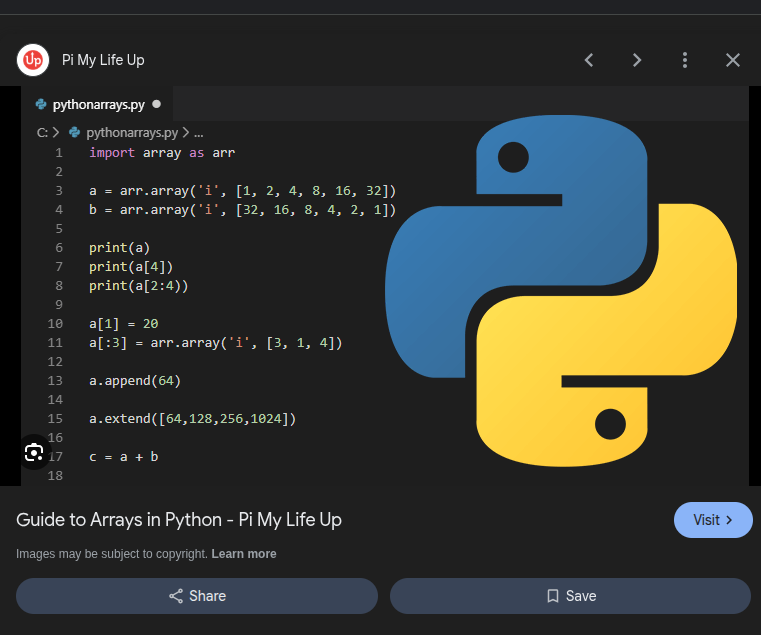
Don’t try to learn Python, JavaScript, and C++ simultaneously. That’s like trying to learn French, Mandarin, and Arabic at the same time — you’ll end up fluent in confusion. For beginners, **Python** is the gold standard. Its syntax reads almost like English, it’s versatile, and it has a massive community. The image at the top of this post? That’s a Python script demonstrating arrays — and it’s a perfect example of how clean and readable the language is.
### Step 2: Learn by Doing, Not Just Watching
Watching tutorials feels productive, but it’s a trap if you’re not coding alongside them. Open a code editor, type the examples yourself, break things, and fix them. That cycle of breaking and fixing is where real learning happens.
### Step 3: Build Small Projects
After a week or two of basics, start building tiny projects:
– A calculator
– A to-do list
– A number-guessing game
– A simple script that automates a boring task
Projects force you to combine concepts, Google solutions, and think like a programmer.
### Step 4: Join a Community
Reddit’s r/learnprogramming, Discord servers, and local meetups connect you with people on the same journey. Coding alone is fine. Coding with support is better.
### Step 5: Be Patient With Yourself
You will get stuck. You will encounter error messages that make no sense. You will spend 45 minutes debugging only to discover a missing comma. Welcome to programming. It’s frustrating, rewarding, and oddly addictive.
—
## Computer Programming Courses for Beginners That Actually Deliver
If you prefer more structure than self-guided learning, **computer programming courses for beginners** are an excellent option. Some are free, some are paid, and some offer certificates that look nice on a résumé.
### Free Courses
– **CS50’s Introduction to Computer Science (Harvard/edX)** — Widely considered the best free intro course on the planet. Professor David Malan’s enthusiasm is contagious, and the curriculum covers everything from C to Python to web development.
– **Google’s Python Class** — A compact, well-structured course designed by Google. It’s no-frills and effective.
– **Automate the Boring Stuff with Python** — This book (available free online) teaches Python through practical automation projects. It’s perfect if you want to see immediate, real-world value from your code.
### Paid (But Worth It) Options
– **Udemy** — Courses often go on sale for under $15. Look for instructors like Angela Yu (100 Days of Code) or Jose Portilla.
– **Coursera** — University-backed courses from institutions like the University of Michigan and Stanford. Many allow free auditing; you only pay if you want the certificate.
– **Boot Camps** — Intensive, immersive programs that compress months of learning into weeks. They’re pricey but effective if you’re serious about a career change.
The best course is the one you’ll actually finish. Fancy branding doesn’t matter if the teaching style doesn’t click with you. Try free options first, and invest money only when you’ve confirmed that programming is something you genuinely enjoy.
—
## Common Mistakes Beginners Make (And How to Dodge Them)
Learning **how to learn programming online** is half the battle. The other half is avoiding the potholes that trip up nearly every new coder.
### Mistake 1: Tutorial Purgatory
This is the most common trap. You finish one tutorial, feel great, then immediately start another… and another… and another. You’re consuming content but never creating anything. The fix? After every tutorial, build something — anything — without following a guide.
### Mistake 2: Comparing Yourself to Experienced Developers
That developer on Twitter who built a full-stack app in a weekend has been coding for years. You’re on Day 12. Comparison is the thief of joy and the assassin of motivation.
### Mistake 3: Trying to Memorize Everything
You don’t need to memorize syntax. Professional developers Google things constantly. What matters is understanding concepts and knowing *what* to search for. Your brain is for problem-solving, not for being a dictionary.
### Mistake 4: Skipping the Fundamentals
It’s tempting to jump straight into building an app or a website. But skipping **basic programming concepts for beginners** — like data types, loops, and functions — will come back to haunt you. Build the foundation first. The skyscraper can wait.
### Mistake 5: Going It Completely Alone
Programming communities exist for a reason. Ask questions. Share your code. Get feedback. Being humble enough to ask for help is a superpower, not a weakness.
—
## Conclusion
Programming isn’t magic, and it isn’t reserved for geniuses in hoodies. It’s a skill — learnable, practicable, and genuinely fun once you get past the initial awkwardness. Whether you’re exploring **programming for beginners** out of curiosity or plotting a full career pivot, the path forward is the same: pick a language, start small, build things, and don’t quit when it gets confusing (because it will, and that’s normal).
The resources are free. The communities are welcoming. The only thing standing between you and your first working program is the decision to start. So open a code editor, type your first line, and welcome to the club. **wearmaan** is rooting for you every step of the way.
Published March 20, 2026 in
Uncategorized